
Few things cause homeowners more anxiety than discovering damp patches on walls or cracks appearing in plaster. Most are benign — properties move and breathe constantly — but some indicate problems that genuinely need professional attention. Knowing the difference saves money on unnecessary surveys and ensures you do not ignore something important.
Need a tradesperson for this?
Bizzy Day lets you search available UK tradespeople by trade, postcode, and date — free, no account needed.
Find a tradesperson — freeTypes of damp
The three main types of damp in UK homes are: rising damp (moisture rising up from the ground through masonry, normally stopped by the damp-proof course), penetrating damp (water getting in from outside through walls, roof, or windows), and condensation (moisture from inside the home depositing on cold surfaces). Condensation is by far the most common and is often misdiagnosed as rising damp. It appears at the bottom of cold external walls, around window frames, and in areas with poor ventilation — and is primarily addressed through ventilation and heating, not chemical injection.
Diagnosing condensation vs rising damp
Condensation damp is typically worst in winter, worse in rooms with high moisture output (bathrooms, kitchens), and appears on cold surfaces. It is usually accompanied by black mould (Cladosporium) on walls and ceilings. Rising damp should be limited to the ground floor, would appear as a tide mark on the lower section of the wall, and would typically cause the plaster to spall and bubble. Genuine rising damp requiring treatment is less common than the damp-proofing industry suggests — independent research has questioned the prevalence of rising damp as a primary cause of wall damp.
The majority of damp problems in UK homes are caused by condensation, not rising damp. A thorough assessment should rule out all other causes before chemical injection is recommended — a treatment that costs £500-£2,000 but may have no benefit if condensation is the true cause.
— Royal Institution of Chartered Surveyors (RICS)
Reading wall cracks
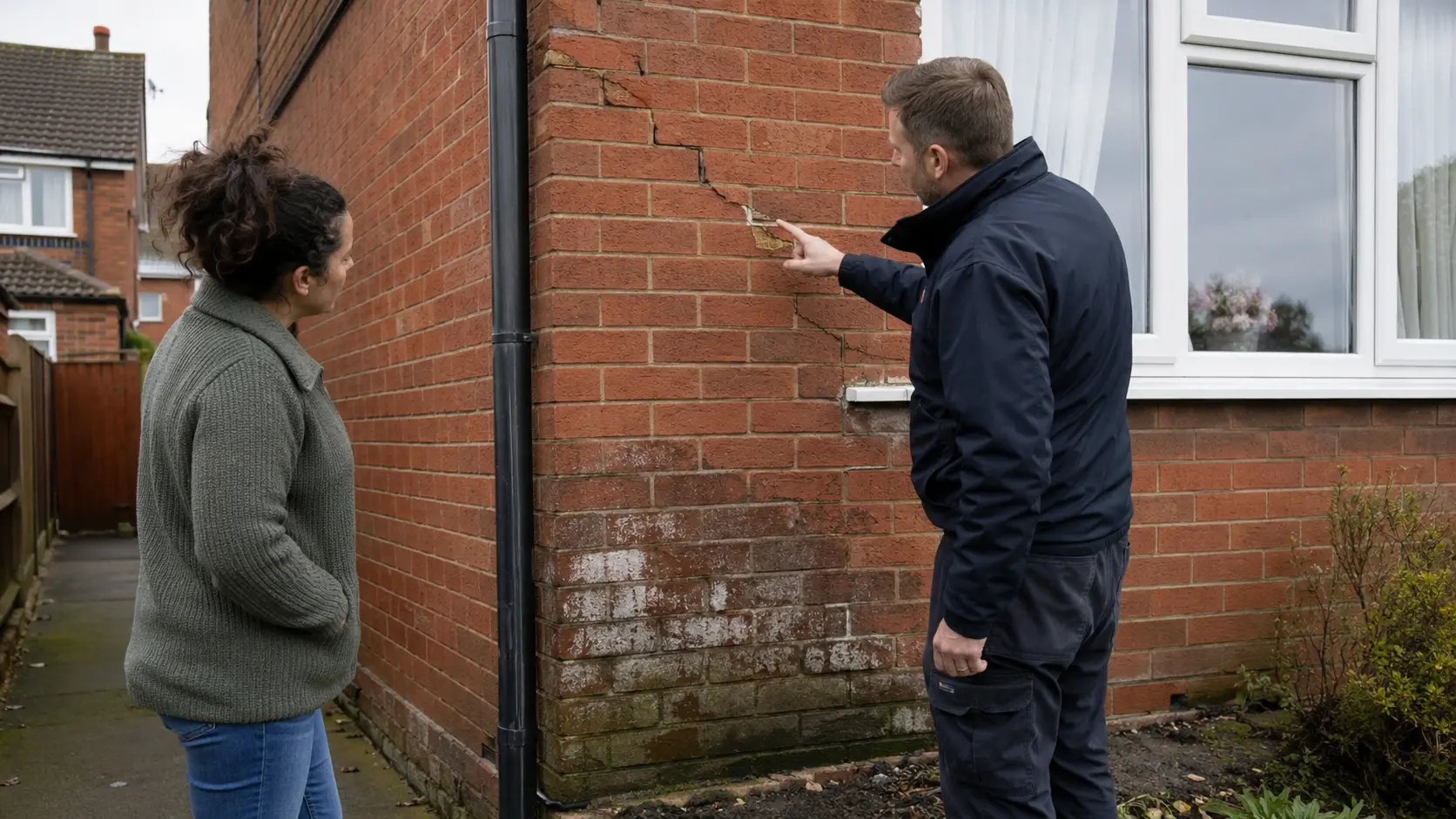
Hairline cracks (under 1mm) in plaster are almost always caused by normal shrinkage and thermal movement — they are cosmetic and need only be filled before decoration. Cracks that are 1-5mm wide may indicate more significant movement but are often still within normal limits for a property settling. Cracks over 5mm, diagonal stair-step cracks in brickwork mortar joints, cracks that taper (wider at one end), or cracks that have opened in one direction (one side displaced relative to the other) warrant professional investigation. These patterns can indicate differential foundation movement.
Subsidence — when to take it seriously
True subsidence — where part of the structure is sinking relative to another — is serious and can be expensive to remediate. Indicators include: doors and windows sticking or becoming misaligned, visible cracking following diagonal patterns from corners of windows and doors, and cracks that continue to widen over time. Properties on shrinkable clay soils (common in London and the south east) near large trees are most at risk. A structural engineer or surveyor should be consulted if you suspect subsidence — not a speculative crack repair service.
Monitor cracks before paying anyone
If you find a crack and are unsure whether it is active (still moving) or historic (stable), mark the ends with pencil and the date, and measure the width. Check it again in 8-12 weeks. A crack that has not changed is historic and likely stable. One that has widened or lengthened needs professional assessment.
- Most damp is condensation — improve ventilation and heating first
- Get an independent RICS surveyor before paying for damp-proofing
- Hairline cracks are normal; cracks over 5mm need assessment
- Diagonal stair-step cracks in brickwork may indicate movement
- Monitor cracks over 8-12 weeks before deciding on action
- Trees near foundations on clay soil are a significant subsidence risk factor