
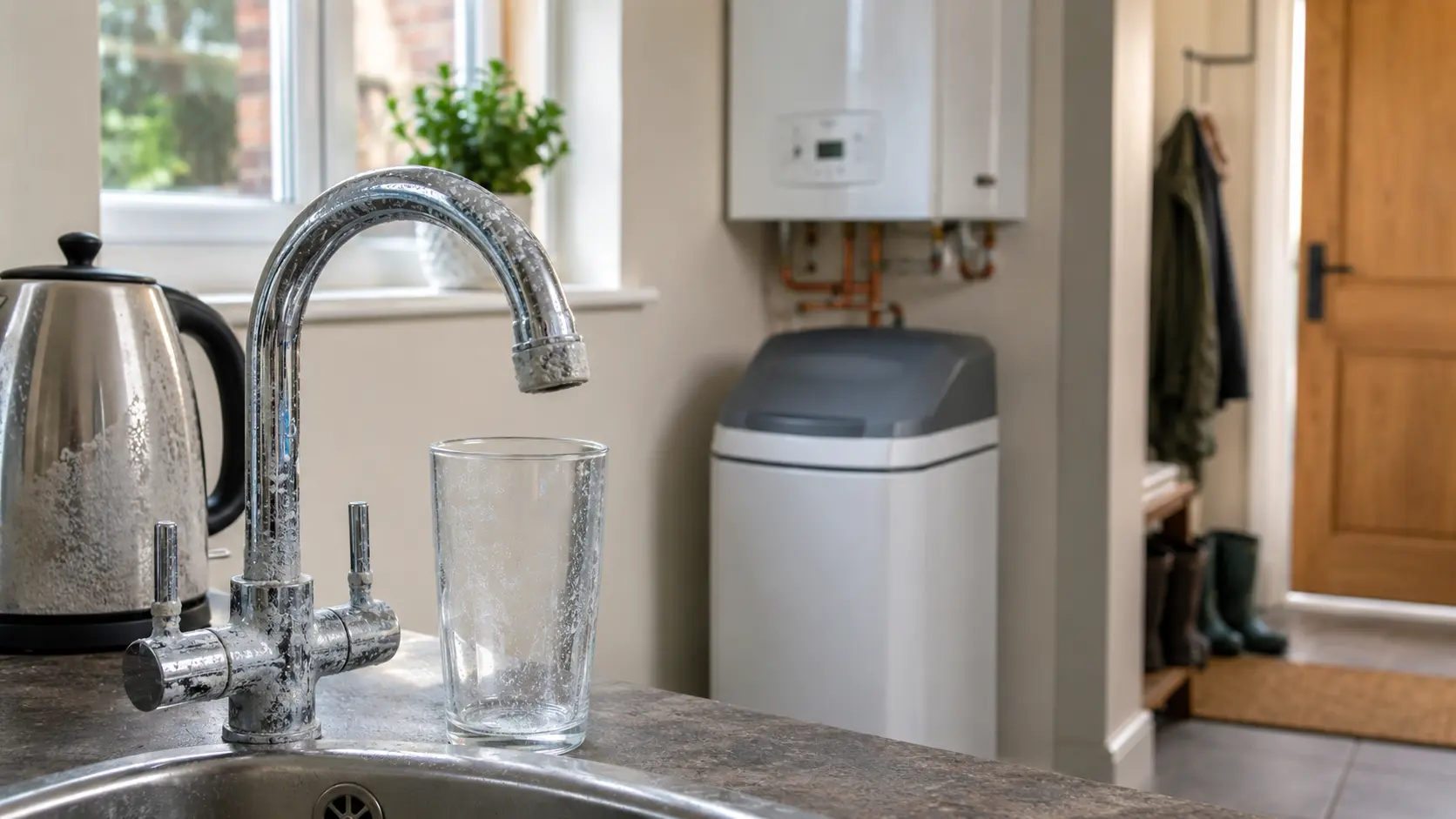
Around 60% of UK homes are in hard water areas, predominantly in the south and east of England. Hard water is not a health risk — it just contains higher concentrations of calcium and magnesium — but it causes real and measurable damage to plumbing, appliances, and boilers over time. Understanding the effects and the options helps you protect your home's systems.
Need a tradesperson for this?
Bizzy Day lets you search available UK tradespeople by trade, postcode, and date — free, no account needed.
Find a tradesperson — freeWhat hard water does to your home
Limescale — the chalky white deposit left by hard water as it heats and evaporates — builds up inside boiler heat exchangers, reducing efficiency and eventually causing blockages. It coats immersion heater elements, shower heads, taps, and kettle elements. In a modern condensing boiler, significant limescale build-up can cause the heat exchanger to fail — a repair or replacement that costs £300-£800. Limescale also makes cleaning harder: soap lathers less effectively in hard water, leaving residue on surfaces, glass, and skin.
Areas most affected
The hardest water in the UK is found in southern England — London, the Home Counties, East Anglia, the East Midlands, and the south coast. Water hardness is measured in mg/l of calcium carbonate: soft is under 100 mg/l, moderately hard is 100-200 mg/l, hard is 200-300 mg/l, and very hard is over 300 mg/l. Parts of Kent, Essex, and Hertfordshire regularly exceed 400 mg/l. Scotland, Wales, and the north of England generally have soft water from upland reservoirs.
In areas with water hardness above 250 mg/l, scale build-up in an unprotected boiler can measurably reduce efficiency within 3-5 years and potentially cause premature heat exchanger failure.
— Water Treatment Association
Water softeners — how they work and what they cost
A salt-based ion exchange water softener replaces the calcium and magnesium ions in the water with sodium ions, producing softened water that does not deposit limescale. Units are typically installed near the incoming mains supply and regenerate automatically using salt pellets. Installation costs £1,000-£2,500 including the unit. Ongoing costs include salt (approximately £150-£300 per year depending on water hardness and usage) and periodic servicing. Leading brands include Harvey Water Softeners, Kinetico, and Clack.
Alternatives to whole-house softeners
Scale inhibitor devices (electronic or magnetic) are much cheaper (£100-£400) and claim to reduce limescale formation by altering the physical properties of the calcium crystals. Evidence for their effectiveness is mixed — some independent studies show benefit, others do not. They are a reasonable option where a full softener is not practical. Limescale inhibitor filters on the boiler mains supply and combi boiler scale reducers (which add polyphosphate to the water) are also available and widely used by plumbers in hard water areas.
- Check your area hardness level via your water company website
- Protect your boiler with a scale reducer or inhibitor filter
- A whole-house softener pays back over 5-10 years in hard water areas
- Note: softened water is not recommended for drinking — maintain an untreated drinking water outlet
- Annual boiler service catches limescale problems before they cause failures