
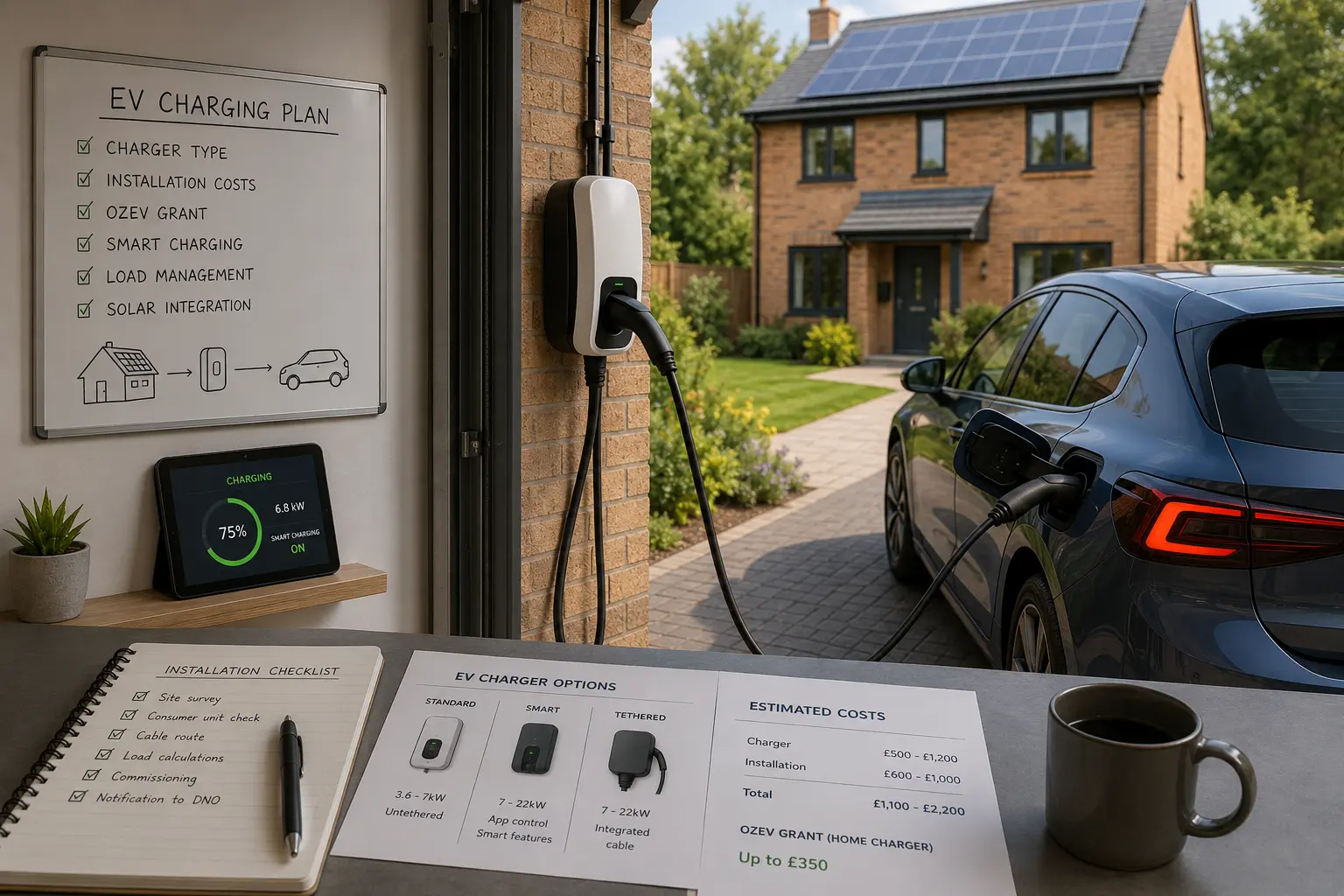
Home charging is the most convenient and cost-effective way to charge an electric vehicle — adding 30-50 miles of range overnight at off-peak electricity rates. Planning the installation correctly, choosing the right charger, and understanding how it interacts with your home's electrical system are all important decisions.
Need a tradesperson for this?
Bizzy Day lets you search available UK tradespeople by trade, postcode, and date — free, no account needed.
Find a tradesperson — freeTypes of home EV charger
A standard domestic socket (2.3 kW) is the slowest option — adding around 8 miles of range per hour. A dedicated 7.4 kW home charger (the standard for most homes with single-phase supply) adds 25-30 miles per hour. Three-phase supplies allow 11-22 kW chargers, but these are uncommon in domestic properties. For most EV drivers, a 7.4 kW charger fully charges a typical EV (60-80 kWh battery) overnight with capacity to spare.
Installation costs and the OZEV grant
A standard 7.4 kW home charger installation costs £800-£1,500 for supply and installation by a registered electrician. The Office for Zero Emission Vehicles (OZEV) offers the Electric Vehicle Chargepoint Grant — £350 towards the cost of installing a smart chargepoint for eligible homeowners (those in flats or rental accommodation; the grant for homeowners with off-street parking ended in 2022). Check the current scheme at gov.uk.
Charging at home on a smart tariff — drawing power at off-peak overnight rates — costs the equivalent of approximately 1-3p per mile. This is significantly cheaper than petrol or diesel equivalents.
— Energy Saving Trust
Smart charging and solar integration
Smart chargers (now required for all new domestic installations) can schedule charging to off-peak hours, integrate with solar panels to charge from excess generation, and participate in demand response programmes. Systems like myenergi Zappi automatically divert surplus solar power to your EV — so if you have solar panels, a compatible smart charger is particularly valuable. Ensure your installer sets up the smart charging functionality, not just the hardware.
Load management and electrical capacity
A 7.4 kW EV charger drawing at full power represents a significant additional load on your home's electrical system. Your installer should check whether your existing consumer unit and incoming supply can accommodate this, and whether load management (reducing charger output when other large loads are active) is needed. In homes with electric heating, heat pumps, or large cooking ranges, load management is increasingly important.