
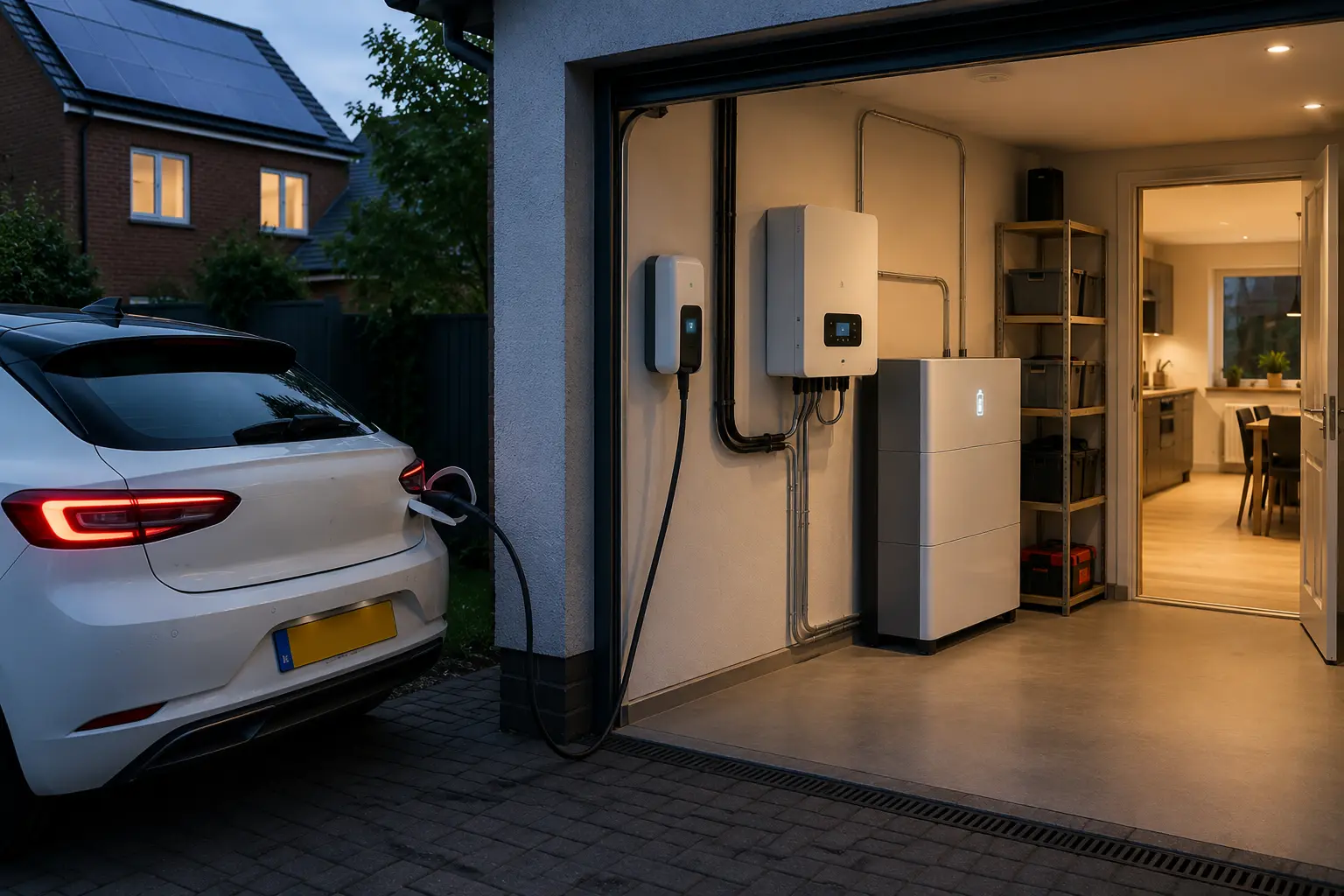
Vehicle-to-Home (V2H) technology allows an electric vehicle's battery to power your home — effectively turning your car into a large home battery. With EV batteries typically ranging from 40-100 kWh, this represents 2-5 days of average household electricity. It is a genuinely transformative technology, but it requires specific vehicle and charger support that is only now beginning to reach the mainstream.
Need a tradesperson for this?
Bizzy Day lets you search available UK tradespeople by trade, postcode, and date — free, no account needed.
Find a tradesperson — freeHow V2H works
V2H uses bidirectional charging — the charger can both charge the vehicle from the grid and discharge the vehicle battery back into the home. The home's electricity circuits are fed from the vehicle battery via a specialist bidirectional charger, rather than from the grid. A home energy management system coordinates between solar generation, the vehicle battery, and grid import/export, optimising for cost and carbon.
Which vehicles support V2H?
V2H requires CHAdeMO or bidirectional CCS charging capability in the vehicle — and currently only a small number of vehicles support this. The Nissan Leaf (older models with CHAdeMO) and Nissan Ariya support V2H. The Hyundai IONIQ 5, Kia EV6, and KGM Musso Electric support Vehicle-to-Load (V2L). Many manufacturers including Volkswagen, Renault, and Ford have announced V2H-capable vehicles for 2024-2025.
V2H technology has the potential to fundamentally change the economics of home energy storage — an EV battery contains 5-10 times the capacity of a typical home battery at a fraction of the incremental cost.
— Energy Systems Catapult
Equipment and installation costs
A bidirectional charger capable of V2H typically costs £3,000-£8,000 installed, depending on the technology and whether it requires a three-phase supply. This is significantly more than a standard home EV charger (£800-£1,500) but considerably less than a standalone home battery of equivalent capacity. DNO (Distribution Network Operator) approval may be required for installations above certain power levels.
V2H impacts vehicle battery warranty
Using your EV battery for home energy storage accelerates cycle usage. Most manufacturers have not yet clarified how V2H affects battery warranty terms. Check with your manufacturer before operating in V2H mode, particularly on newer vehicles where this technology is not explicitly covered by the warranty documentation.