
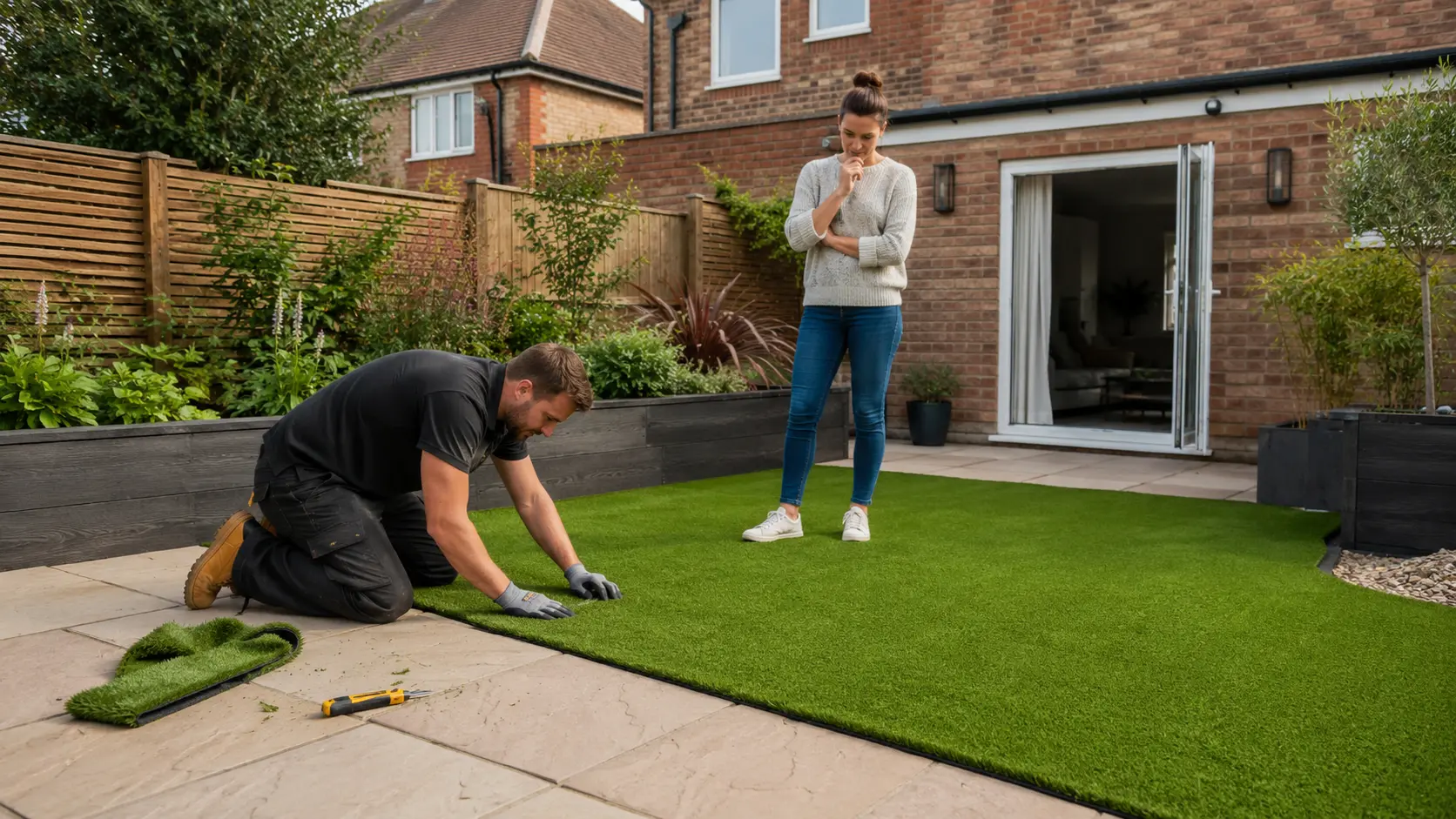
Artificial grass has become one of the most popular garden upgrades in the UK, particularly for families with young children, homeowners with shaded or high-traffic areas, and those wanting a low-maintenance garden. But it is also one of the most misunderstood products — quality varies enormously, installation matters hugely, and there are genuine environmental concerns to understand before you commit.
Need a tradesperson for this?
Bizzy Day lets you search available UK tradespeople by trade, postcode, and date — free, no account needed.
Find a tradesperson — freeQuality and what to look for
Artificial grass is graded primarily by pile height, density (stitches per square metre), and fibre composition. Pile heights of 25-40mm suit most residential gardens. Density matters more than pile height — a low-density grass looks sparse within a year or two of heavy use. Polyethylene fibres are the most natural-looking and soft underfoot; polypropylene is cheaper but less durable. Always feel the product: good artificial grass should not feel scratchy, and the fibres should stand upright, not flatten immediately under hand pressure.
Installation — why it matters so much
The most common reason artificial grass fails — looks bad, drains poorly, or develops lumps — is poor installation, not the product itself. A proper installation involves: removing the existing lawn to a depth of at least 75-100mm, installing a compacted sub-base of crushed aggregate (MOT Type 1), laying a weed membrane over the sub-base, and fixing the grass with adhesive joins and securing pins at the perimeter. Cutting corners on any of these steps leads to problems within 1-2 years.
The sub-base is the part of the artificial grass installation that no one sees — and the part that determines whether the grass lasts five years or fifteen. Never skip the proper aggregate compaction stage.
— Landscape Institute
Costs
Supply and installation of artificial grass typically costs £40-£80 per square metre in England, depending on the quality of grass chosen and the complexity of the groundworks. A 30-square-metre garden laid to a reasonable specification (proper sub-base, mid-range product) typically costs £1,800-£3,000 fully installed. Very cheap "artificial grass" offers (under £20/m² supply only) are invariably poor quality — the fibres degrade quickly in UV and flatten under traffic.
Environmental concerns
Artificial grass is not without environmental impact. It creates a non-permeable surface that contributes to urban runoff (though most products include drainage holes that allow some water through). It reduces biodiversity — grass roots and soil organisms are eliminated beneath it. It is a plastic product that will eventually end up in landfill, as recycling routes for end-of-life artificial grass are still limited. It also contributes to urban heat island effects, as it absorbs and radiates more heat than natural grass. These are real trade-offs worth acknowledging.
Consider a hybrid approach
Rather than replacing all of your lawn with artificial grass, consider reserving artificial grass for the heaviest-use areas (play areas, pathways, patchy shaded zones) while maintaining natural grass elsewhere. This preserves biodiversity while resolving the practical problems artificial grass is best suited to solving.
- Pile density matters more than pile height for durability
- Always include a proper crushed aggregate sub-base
- Budget for groundworks — they are as important as the product
- Avoid very cheap products; the UV degradation is rapid
- Ask for a 10-year product guarantee from the manufacturer