
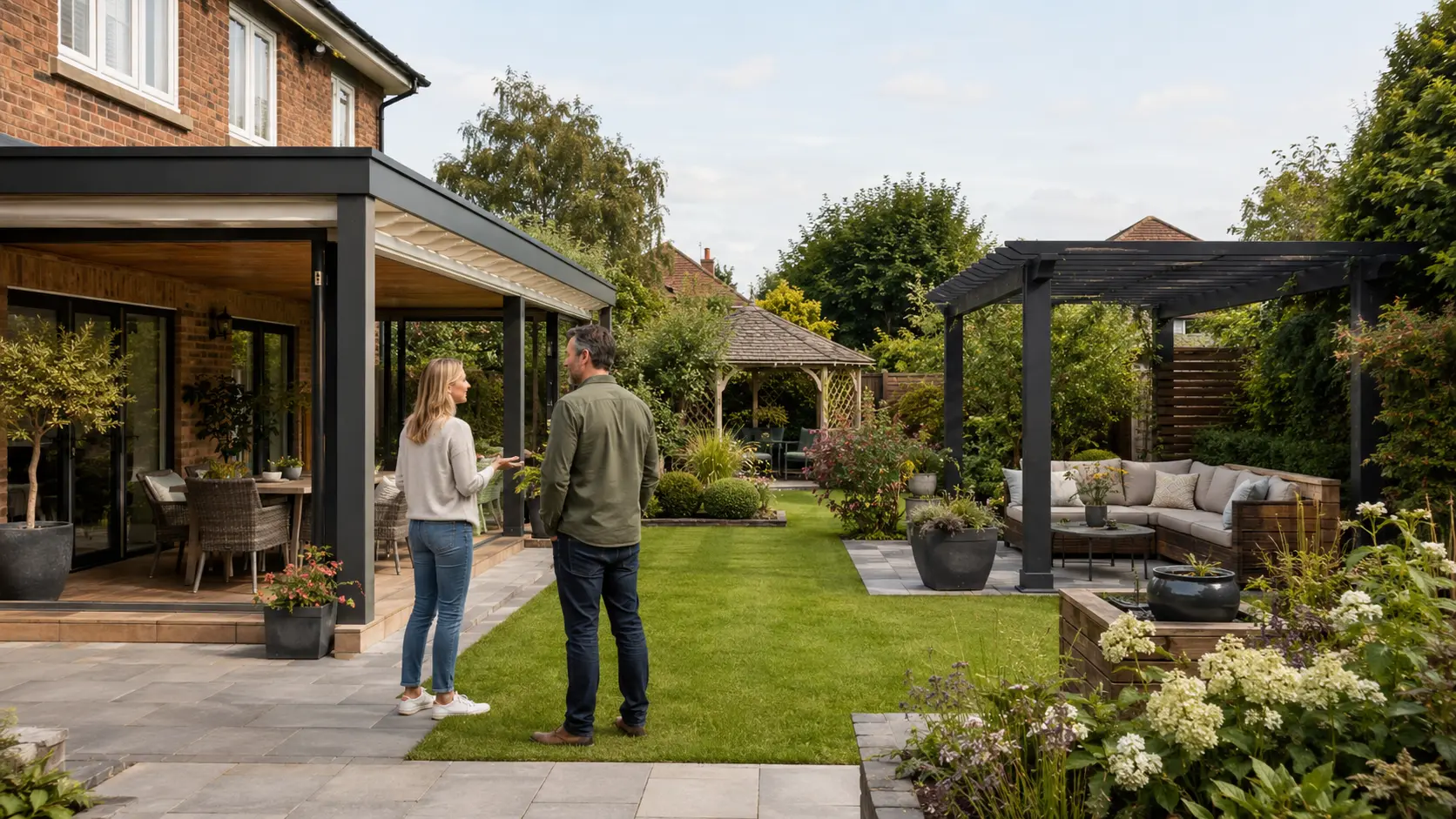
Pergolas, verandas, and gazebos are often confused — they look broadly similar from a distance, but differ significantly in structure, function, and planning requirements. Understanding the differences will help you choose the right structure and avoid expensive planning mistakes.
Need a tradesperson for this?
Bizzy Day lets you search available UK tradespeople by trade, postcode, and date — free, no account needed.
Find a tradesperson — freeWhat is the difference?
A pergola is an open framework — typically four posts supporting a slatted or open-beam roof with climbing plants or fabric shade. It provides filtered shade but not weather protection. A veranda is an attached covered walkway or sitting area adjacent to the house, with a solid or semi-solid roof that provides genuine rain cover. A gazebo is a freestanding structure with a solid roof, typically octagonal or square, positioned elsewhere in the garden. Lean-to structures attached to the house wall are closer to verandas than pergolas.
Planning permission requirements
A freestanding pergola or gazebo in the garden typically falls under permitted development if it meets the standard outbuilding limits: single storey, eaves no higher than 2.5 metres, maximum height of 4 metres (or 3 metres with a flat roof), covering no more than 50% of the garden. A veranda attached to the house is treated differently — most lean-to structures attached to the house wall require planning permission if they have a solid roof and provide weatherproof cover, as they are considered extensions rather than outbuildings.
An attached veranda with a solid roof is a house extension in planning terms — even if it looks like a simple garden structure. Always check with your local planning authority before attaching anything to the house wall.
— Planning Portal (UK)
Materials and costs
Pergolas range from basic pressure-treated timber kits (£500-£2,000 supply only) to bespoke oak-framed structures with retractable louvre roofs (£8,000-£25,000 installed). Aluminium-framed pergolas with motorised louvre roofs have become very popular — they cost £4,000-£15,000 depending on size and specification, offer genuine weather protection, and require virtually no maintenance. Verandas in aluminium typically cost £3,000-£10,000 installed; timber verandas with solid tiled roofs can reach £15,000-£30,000 or more.
Louvre roofs — the growing trend
Motorised aluminium louvre roofs have transformed the outdoor living market. The adjustable blades rotate from fully open (allowing sun through) to fully closed (providing waterproof cover), with built-in drainage channels in the frame. LED lighting, heaters, and retractable side screens can be integrated into the same frame. These systems are sold by specialists including Renson, Weinor, and a growing number of UK installers. They are significantly more expensive than static pergolas but provide genuine all-weather use.
- Pergola = open frame, shade only, no rain cover
- Veranda = attached to house, solid or semi-solid roof, planning likely needed
- Gazebo = freestanding, solid roof, typically permitted development
- Louvre roofs offer the best weather flexibility for outdoor dining areas
- Always check planning status before attaching anything to the house wall