
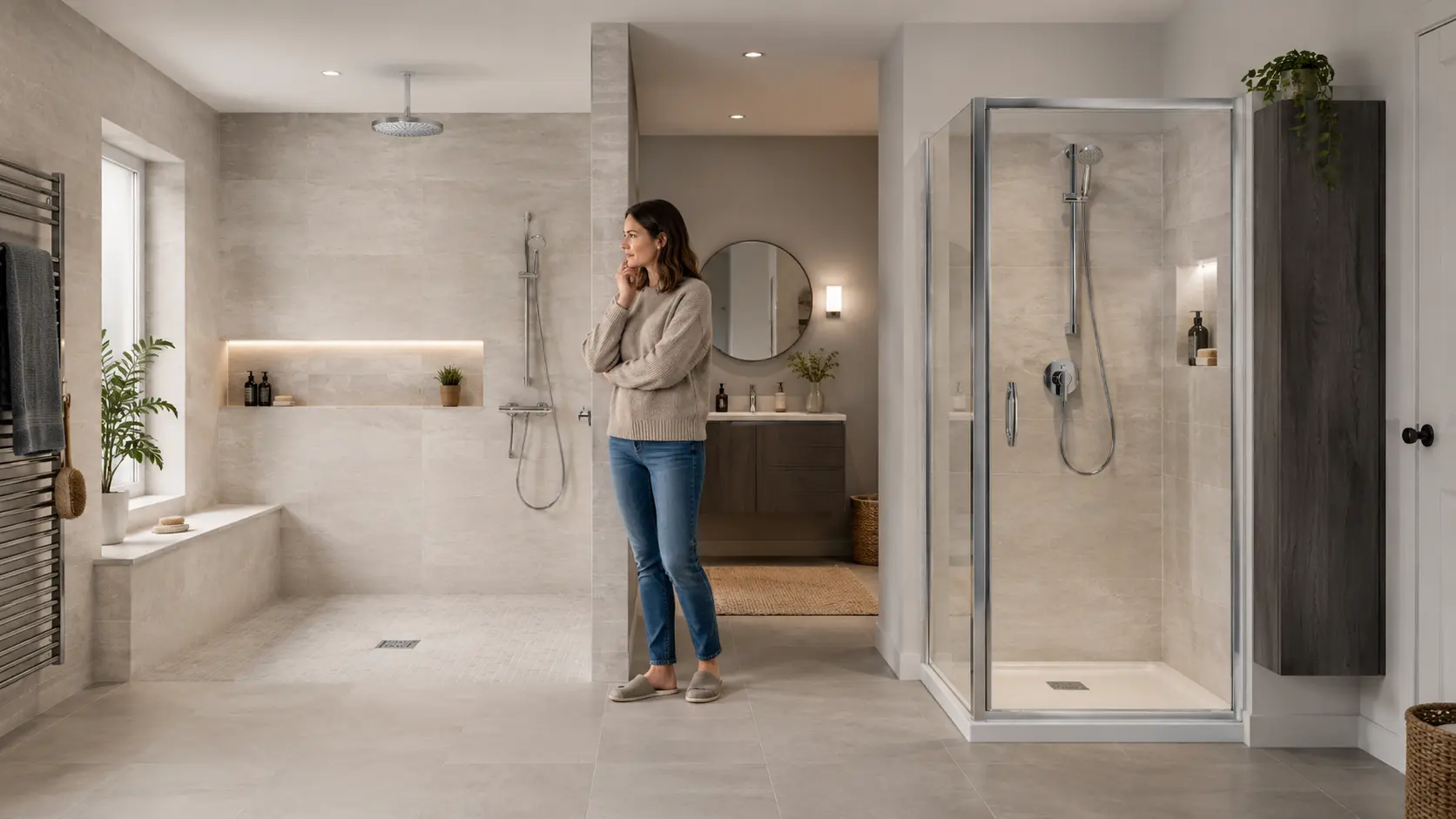
Wet rooms — open shower areas without a tray or screen — have moved from hotel-only luxury to a mainstream bathroom choice in the UK. They look sleek, feel spacious, and are highly practical for people with mobility issues. But they also have higher specification requirements and greater consequences if the waterproofing is not done correctly.
Need a tradesperson for this?
Bizzy Day lets you search available UK tradespeople by trade, postcode, and date — free, no account needed.
Find a tradesperson — freeWhat is a wet room?
A wet room is an open shower space where the floor is fully waterproofed and drained, typically with a linear drain at one edge or a point drain at the centre. There is no shower tray — the shower floor is continuous with the rest of the bathroom floor, sloped slightly towards the drain. They can be used with a glass screen (for practicality) or fully open. They are especially popular in en suite bathrooms and for accessibility adaptations.
The waterproofing requirement
A wet room requires a completely sealed waterproof system across the entire floor and walls to at least 1800mm height in the shower area. This is more demanding than a standard shower enclosure, where waterproofing is only required on the shower walls and floor. The screed must be laid to a precise fall (minimum 1:80 gradient) towards the drain. Any error in the waterproofing or screed falls results in pooling water and eventual water ingress.
A wet room is only as good as its waterproofing. The most common failure is inadequate tanking in corners and around the drain — areas that require specific reinforcing tape and system-correct materials.
— Tile Association
Advantages of a wet room
Wet rooms look dramatic and feel spacious — the absence of a tray and screen creates an open, airy feel even in a compact bathroom. They are significantly easier to keep clean than a shower enclosure with tracks and seals. They are ideal for people with reduced mobility or wheelchair users — there is no threshold to step over. The glass screen (where used) requires less cleaning than a fully enclosed cubicle.
Advantages of a traditional shower enclosure
A traditional shower enclosure with a tray is simpler and cheaper to install correctly — the tray provides a sealed water collection point, reducing the waterproofing demands on the floor. It is a better choice on timber-joisted floors (where the structural implications of a screed wet room are significant), in rented properties where the landlord wants a simpler solution, and in houses where the bathroom sees light use.